Author Archives: Rosanne Parry

Promotion and the Big Publishing House

The hook I see self-publishing presses use more often than any other is to claim that the major publishing houses no longer promote the books they publish. They suggest that authors are all on their own even at the big houses to arrange their own publicity, so you might as well go with a self-published press and get a bigger share of the pie. It’s a tempting line of thinking but one which can sometimes prompt a decision a writer later regrets.

Harold Underdown has an excellent post on the things a traditional publisher does for your book here. This is my take on the issue. I have a novel out this year. It’s one that I’ve worked on for more than 15 years and is very dear to me. My publisher, Random House, is not sending me on a book tour or buying product placement for me in the chain bookstores or featuring me at the big book conferences–BEA and ALA. And am I upset? Not in the least! Here’s why.

Nobody expects this book to be a blockbuster, not my publishers, not my reviewers, and not me. We all know that what we’ve got here is a solidly written book that will be of interest to fans of historical fiction and useful to teachers and librarians. It’s exactly the kind of book which never gets attention in the self-publishing market which is a great place to discover a highly commercial book like Fifty Shades of Gray but a dismal venue for a literary children’s novel. But with a traditional publishing house we don’t need Written in Stone to be a blockbuster. We just need it to reach it’s intended audience. And to that end my publisher has done a number of extraordinarily intelligent (but not highly visible) things in the marketing of this book.

1. Editorial Process

First and foremost I have the expertise of an editor with lots of experience and a heart for what makes a book work for a kid reader. He also knows what the school and library market is looking for so he made sure I got all the room I needed for a detailed authors note. And did I have to pay him? Nope. Part of the package.

2. Cover design

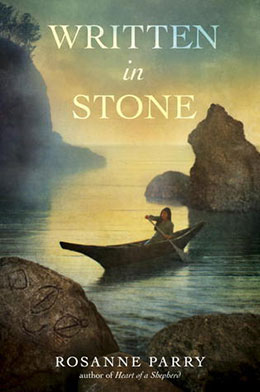
I love this cover! It does everything a cover needs to do and is a work of art besides. Did I have to find the nationally known artist Richard Tuschman and convince him to do this work? Nope. All that coordination and design work was done by the talented cover team at Random House. They took the few reference photos I sent and their own love of story and made magic happen.

3. Reviews

One of the hardest things to do as a self-published author is to get review attention for a book, even a really good book. I don’t even have to think about it. Part of the package.

4. Teacher’s guide

Pat Scales made a gorgeous teachers guide and my publicist has been great about sending copies of it out to bookstores doing fall teacher previews. Even better, you can download it for free. Because I’m a teacher I could have made this on my own, but it would have taken weeks of research through the common core to do it properly and then there is the design and layout–an entirely different skill set which I do not possess.

5. Sales Reps

Because my book is of regional interest the local sales reps at Random House featured the book in their meetings with the largest library systems in the northwest. It not only encourages book purchase but highlights the title to the group of people who sit on award committees and choose state-wide reading lists. It’s a very smart move and not something I could ever set up on my own for just one book.

6.Book Tour

Here is the best part: they didn’t send me on a book tour! A tour is expensive and puts a lot of pressure on the author to recoup the expense in book sales. Instead they’ve let me set up my own book events in venues where I know I can generate interest, with book sellers who have supported me in the past, and at schools who are invested in bringing me to speak to their students. I get to pick a schedule that works with my family’s commitments. I can take advantage of family or sports events travel and couple it with speaking engagements. I can pull together something at last minute to do a favor for a friend who is suddenly without a speaker at their conference. I can plan a whole year in advance for a week long author-in-residence. Yes, this is a lot of work, but the payoff in terms of relationships built in the business will benefit me for years to come so it’s time well worth investing.

7. Support

Even though they aren’t flying me all over the country, they are supporting me in my travels with timely responses to my communications, and on time shipments to the bookstores where I speak. They’ve never missed a shipment–not once. They keep my back list in good supply. I never have to worry if the books will be there. This reputation is one of the reasons bookstores are willing to have me in. They make it look easy to have a seamless supply and delivery of books, but I bet it isn’t.

8. Prompt conversion to paperback

About half the schools I contact for visits want to wait until my title is in paperback so that they can afford a full classroom set and the students can afford to buy their own book. No problem! The paperback comes out in a year. We can go ahead and schedule into next school year knowing an affordable book is on the way. And just like all the rest, it’s part of the initial contract I don’t have to make it happen all on my own.

None of this is intended to disparage self-published work. There is outstanding craft in self-published books. I’m very excited to see a new book award from SCBWI for self-published work. But I’m also sad for people who have been swan-songed into going it alone on a book that would be better served in a traditionally published venue. So before you decide to go it alone, think about what you are turning down with a traditional publisher. It might be worth the wait and the careful rewriting and polishing of your story to get your foot in the door.


Middle Grade Monday Book Review

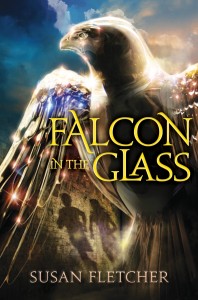
The Falcon in the Glass by Susan Fletcher

Falcon in the Glass (2)In Venice in 1487, the secrets of glassblowing are guarded jealously. Renzo, a twelve-year-old laborer in a glassworks, has just a few months to prepare for a test of his abilities, and no one to teach him. If he passes, he will qualify as a skilled glassblower. If he fails, he will be expelled from the glassworks. Becoming a glassblower is his murdered father’s dying wish for him, and the means of supporting his mother and sister. But Renzo desperately needs another pair of hands to help him turn the glass as he practices at night.
One night he is disturbed by a bird — a small falcon — that seems to belong to a girl hiding in the glassworks. Soon Renzo learns about her and others like her — the bird people, who can communicate with birds and are condemned as witches. He tries to get her to help him and discovers that she comes with baggage: ten hungry bird-kenning children who desperately need his aid. Caught between devotion to his family and his art and protecting a group of outcast children, Renzo struggles for a solution that will keep everyone safe in this atmospheric adventure.

Three things for the reader to like

1. I have always loved books that took me some place new and immersed me in that world and this one does it in spades. Not only do we get oodles of rich detail about Venice (one of my favorite places in the world) we also get a detailed look at the art and life of a glassblower–something I knew nothing about.

2. It seems that I often hear either plot or beautiful language praised as if these two things are mutually exclusive. Here is a counter example. There are lovely, though not over wrought, phrases on nearly every page. And there is a compelling plot, with twists and turns and murky bits, befitting the medieval canal town.

3. There is also plenty of insight into a boy trying to make it in a man’s world. I particularly liked the moment when Renzo broke into the carpentry shop of his mother’s suitor. He had great scorn for this man, but seeing how well the carpenter keeps his tools, Renzo has a new perspective and greater respect for him even though he is a member of a comparatively lowly profession. It’s a small moment in the overall story but a telling and insightful detail.

Something for the writer to think about

This book raises a perennial question for me. How magic does magic have to be? Some readers want everything clearly spelled out and others love the mystery that invites personal interpretation and mental embellishment. In this book, the “bird children” are able to communicate with birds telepathically. It’s a small but vital detail in the plot.

But the reason the kids can ken with birds is never stated. The mechanism by which they communicate is never spelled out in detail. I was curious about both things and a little bummed never to learn what I wanted to understand. It’s a fine book anyway and it got me thinking about how much needs to be said about magic in a story and how much can be left open.

How about you readers. How much do you want to know about the magic and how it works?

Middle Grade Monday Book Review

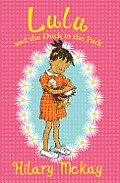
Lulu and the Duck in the Park by Hillary McKay

9780807548080

I’ve been working on a series for younger readers all summer long and part of my work was reading a bunch of books in early middle grade fiction that are already available. This one was recommended to me by a friend. I got it from my local library. I was eager to read this one because it was very well reviewed, garnering 5 starred reviews.

Here’s what it’s about:

Lulu loves animals. When Lulu finds a duck egg that has rolled out of its nest, she takes it to class to keep it safe. Lulu isn’t allowed to bring pets to school. But she’s not really breaking the rules because it’s just an egg. Surely nothing bad will happen… A fun-filled new series for early readers and animal lovers alike.

Three Things for a Reader to Like

1. This is spot on for the tender-hearted reader. There’s enough tension but not too much. If Lulu brings another animal to school they will have to give up the beloved class guinea pig and have stick insects for a class pet instead–dreadful! And yet not dire or night mare producing.

2. Lulu is very appealing in her genuine and unabashed affection for all creatures great and small. She has a true blue best friend and a teacher who is stern enough to provide a formidable obstacle, but not so stern that she can’t also be part of the resolution.

3. I hear plenty of call for books with a non-white protagonist in which race is not the issue of the book. Well here you go! Lulu is a brown skinned girl with brown eyes and curly hair. Her best friend is of her same complexion, yet race and the usual class issues that surround such books is not an issue at all. I hope when people are making their lists of books with non-white characters that this one comes to mind.

Something to think about as a writer

So here is a “multicultural book” where the main character is clearly not white and yet in the text there is nothing at all to indicate her race, ethnicity, class, or cultural heritage. So is this cheating? Should a non-white character have something in her voice, or dress or manner of interacting with others the indicates an different point of view? I’m really not sure. I love it that Lulu is a little “every girl” and yet I wonder, is that really serving the non-white reader of the book well. I wish I had a good answer for that, but I’m not sure.

What do you think readers? Is it enough to just illustrate a character as non-white or is it important to say something about a characters background as well? I’d love to hear your thoughts in the comments.


Gratitude for Booksellers and Librarians

My parents first took me to Powells Bookstore clear back in 1972 or so when it was a tiny place tucked away in northwest Portland. I’ve been a fan of indy bookstores ever since. In fact the kind of books I write would not be possible without knowledgeable and passionate booksellers helping readers find just the right fit.

Written in Stone by Rosanne ParrySo I was elated today when I saw that the independent bookstore Andersons in the Chicago area had named WRITTEN IN STONE to it’s 2013 Mock Newbery list. The complete list of 25 contenders for the Newbery medal here at the Anderson’s website.


6-8 Poster

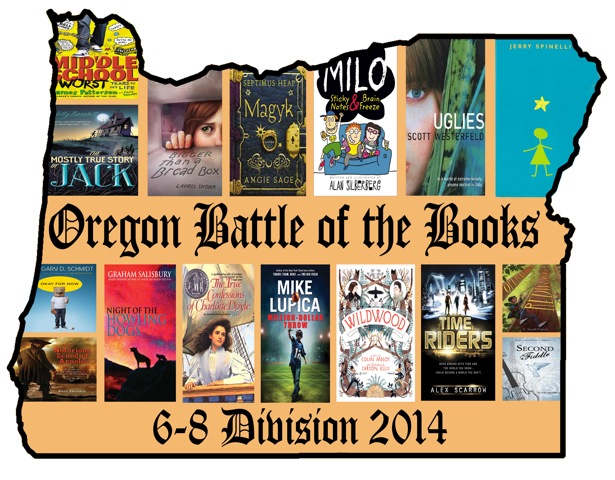
I am also very grateful to the librarian’s who have chosen Second Fiddle for this years Oregon Battle of the Books list for 6th to 8th graders. It’s a fabulous program where kids form teams, read a slate of 15 books, and answer questions about them in a quiz bowl format. It’s great fun and I’m proud to be on the same list as my friends Laurel Snyder with Bigger than a Breadbox, Operation Redwood by S. Terril French, and Night of the Howling Dogs by Graham Salisbury. If your school does not know the joy of the book battle here’s where you can go for more information. 

So happy new school year to all you wonderful school librarians who do so much to help kids find books to grow on.

And a big thank you to the following independent bookstores who have invited me to come share my books. I’ll have a full list of bookstore appearances up on my calendar soon.

A Children’s Place Bookstore in Portland, OR

Waucoma Books in Hood River, OR

Klindt’s Bookstore in The Dalles, OR

Rediscovered Bookshop in Boise, ID

Aunties Books in Spokane, WA

Village Books in Bellingham, WA

Secret Garden Books in Seattle, WA

The Linden Tree Books in Los Altos, CA

Stay tuned for dates and times!

Revision from the orchard tenders point of view

I have the wonderful luck to live in a historic home in Portland, Oregon. It’s the best preserved example of a gothic farmhouse in the area, and it has big yard which contains historic fruit trees. We have cherries, walnuts, apples, peaches, plums, and pears. I love working with trees that are probably more than 100 years old and I love having fresh fruit for pies and jams for my family. But to be honest, fruit trees are a lot of work.

aaadownloads 001When I’m taking a writing break in the summer I’ll often climb down from my treehouse and get out the old orchard ladder and spend some time on my back yard orchard. Because I don’t spray the fruit, I lose a substantial amount of the harvest to insect or disease damage. The sooner I get those blighted or undersized fruits off the tree the better. And then comes the harder task. I need to pick perfectly good fruit before it’s ripe and throw it away.

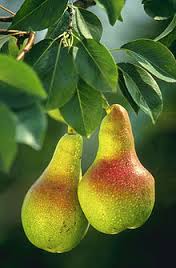
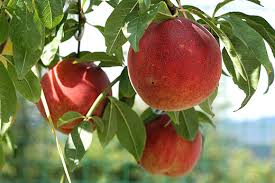
I know. My inner skin-flint cringes at the waste. But the truth is a tree will put out more fruit than it can ripen in a season. So I will go along the branches looking for clusters of 3 or more peaches, pears or apples and remove one or two from the cluster so that the remaining fruits get enough light and water and energy from the tree to ripen fully.Unknown   I hate to do it but when I’ve neglected this task I’ve come away with a crop of apples or pears that never fully ripens and the entire harvest is worthless.

This year I learned an even harder lesson. I only have 2 peach trees. It’s a challenge to grow peaches in Oregon’s cool climate, so some years I get no peaches at all or less than a dozen. But for some reason this year I got a bumper crop. I love peach pie. Lavender peach jam is a big favorite with my whole family. So I didn’t thin the peaches as aggressively as I should and my peach tree broke under the weight of the crop. The whole tree fell over–a complete loss.

imagesAnd what does this have to do with writing? I’ve learned the hard way that just because a section of my story is good and fun and beautiful doesn’t mean it belongs in the book.  My first pass in revising is of course like the first pass in orchard tending–get rid of the rotten. Cut what’s not working. I might need the help of my critique group or editor to recognize what’s not working, but once located it’s not hard to ditch spoiled fruit or lackluster prose. The tricky part is cutting what is beautiful and without fault in the service of the larger story.

Here’s an example from a story I’m still working on. It had two characters who were too strong to be in the same book. Both characters had and interesting arc and strong emotional pull. The voice of my main character at several points was overwhelmed by this second character. The result was that the book as a whole didn’t work. It was a fallen tree of a story and I didn’t know how to fix it. I pouted about this for a while. But I came to see that there was no way both of those characters would ripen on the same tree. And here is where writing books is better than tending an orchard. I wrote two books–started over with different settings and adjusted premises. I let each character develop without having to compete for reader loyalty in the same book. I’m still in the thick of working out these two stories but with a little luck and a lot of hard work, I hope to have two viable fully-ripened stories instead of one.