
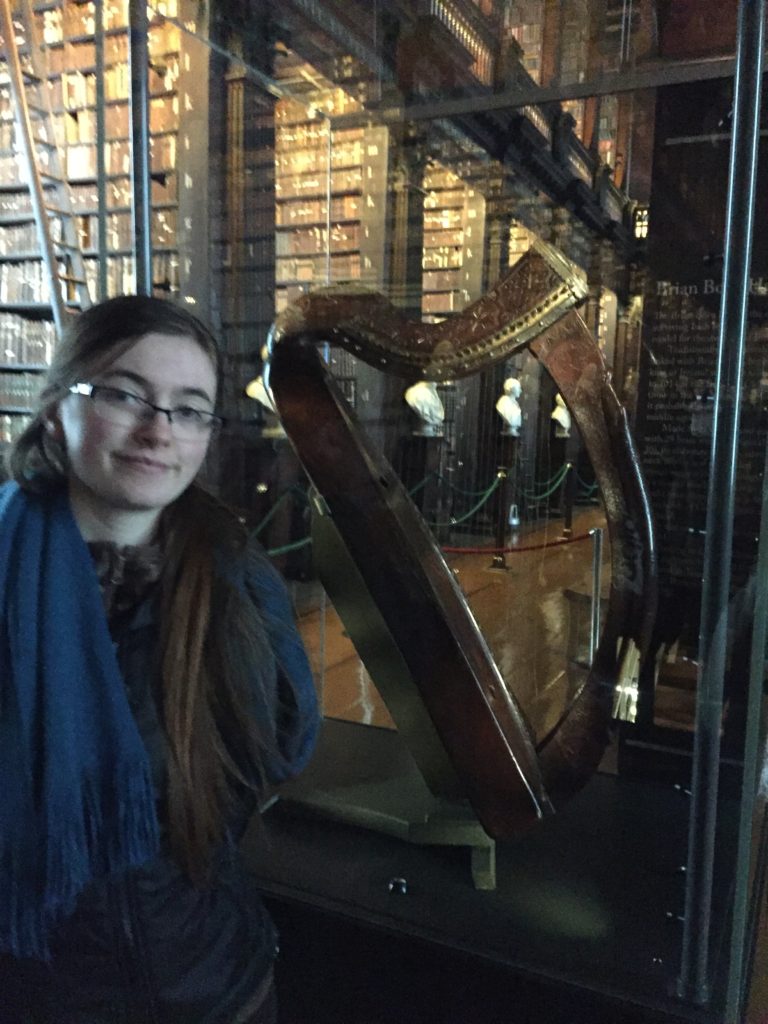
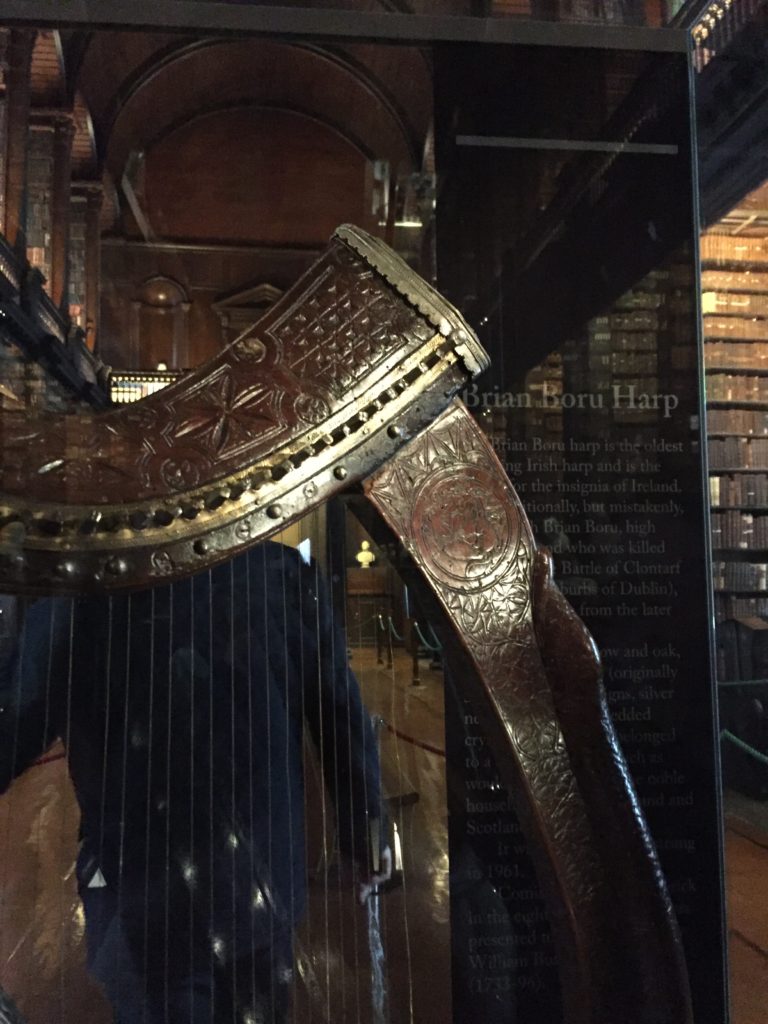
I had such a wonderful time talking with the family history program at the New York Historical Society about LAST OF THE NAME today! There were some questions about harps so I thought I’d show some pictures I have from a trip to Ireland in 2017. This is the Brian Boru harp on display at Trinity College in Dublin. It is one of the oldest harps in Ireland and is the size and shape of the one I imagined my characters carrying in the story. As you can see, it’s ornately decorated. It’s strung with wire and is 600-700 years old.
Here is what a small harp sounds like. I’m a new harp student myself so I have plenty still to learn. The tune I’m playing was written by a very famous harper Turlough O’Carolan who lived from 1670 to 1738. Like many harpers he was blind. He composed many tunes. The ones that have the word Planxty in the title are songs in praise of a person, so this tune Planxty Irwin is a song in praise of Captain Irwin.
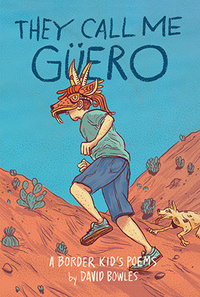 THEY CALL ME GÜERO by David Bowles is a collection of poems which together form a loose narrative about a boy living in South Texas and occupying the physical but also social and emotional space that spans the US-Mexico border. The poems are short and ring clear with emotional and physical details that will strike a chord with any reader. There are many words in Spanish but none that would be a barrier to a reader who knows only English. The glossary in the back is more a courtesy than a necessity. Teachers will be delighted to find many poetic forms and devices used throughout which make it ideal for using in school. I also found it notable in that it doesn’t shy away from the main character’s spiritual practice. A gem from Cinco Puntos Press
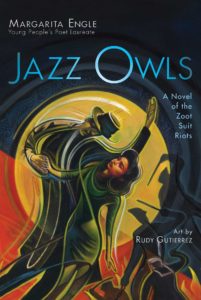 My favorite verse novel in quite a while is JAZZ OWLS: A NOVEL OF THE ZOOT SUIT RIOTS by Young People’s Poet Laureate, Margarita Engle. She takes on an episode in our national history that should be far better known–a racially targeted riot between soon to deploy WWII sailors in Los Angeles and the Hispanic community there. Engle’s spare language and vivid descriptions bring to life a time when the military was still racially segregated, a time when interracial marriage was not legal in California–only 75 years ago. This would be such a great book to discuss in a classroom or book club. The references and afterward make it clear that, as vicious as the racial attacks on Mexican-American’s were, justice was done in the end. The military did integrate and freedom to marry a person of another race did become legal. Still it’s chilling to see how easily the sailors of the 1940s found it to scape goat the Mexican community and how reluctant local law enforcement was to arrest servicemen on the eve of deployment. The art by Rudy Guitierrez strikes just the right tone. This is a gem of a book which I hope will find its way into many a high school history class.