 What a treat to spend the weekend with Oregon’s school librarians. And then hearing keynote speakers R. Gregory Christie and Mitali Perkins was just the icing on the cake.
For those who came to my presentation, here are the books I talked about in my session. A selection of new books that are notable in quality and diverse.
Picture Books
Shanyaak’utlaax Salmon Boy from Baby Raven Reads (Tlingit)
The Woman Carried Away by Killer Whales from Baby Raven Reads (Haida)
Picking Berries by Hannah Lindoff from Baby Raven Reads (Tlingit, Haida, Tsimshian)
Raven Brings Us Fire, Raven and the Box of Daylight, Origins of Rivers and Streams: a raven story by Pauline Kookesh Duncan from Baby Raven Reads (Tlingit)
On our Street: our first talk about poverty, and On the News: our first talk about tragedy by Dr. Jillian Roberts
You Hold Me Up by Monique Gray Smith (Cree & English) Canadian Reconciliation
Speaking our Truth a journey of reconciliation by Monique Gray Smith Canadian Reconciliation
How Raven got His Crooked Nose an Alaskan Dena’ina Fable by Barbara J Atwater (Athabaskan)
Whisper of the East: tales from Arabia by Franziska Meiners -glossary plus activities
The Atlas Obscura: Explorers Guide for the worlds most adventurous kid by Dylan Thuras & Rosemanry Masco
Mapping Sam by Joyce Hesselberth —STEM
The Rabbit Listened by Cori Doerrfeld —empathy
Me and my Fear by Franscesca Sanna
Drawn Together by Dan Santat multi-lingual family
We are Grateful Otsaliheligaby Traci Sorell (Cherokee)
Chapter Books
Baby Monkey Private Eye by Brian Selznick
Digging Deep by Jake Maddox—a hijabi athlete
You Choose Books Sleeping Beauty by Jessica Gunderson—a female fairytale choose your own adventure.
Meet Yasmin by Saadia Faruqui
Lucy’s Lab by Michelle Houts
Jasmine Taguchi Super Sleuth by Debbi Michiko Florence (series)
Pocket Pirates: The Great Cheese Robbery by Chris Mould (series)
The Questioners Rosie Revere and the raucous riveters by Andrea Beaty maker mystery
MG novels
The Journey of Little Charlie by Christopher Paul Curtis – About a boy who engages in slave catching and has a change of heart. tangential to Elijah of Buxton
Running on the Roof of the World by Jess Butterworth
About buddhist refugees from Tibet to India. Yaks!
Marcus Vega Doesn’t Speak Spanish by Pablo Caraya—extra tall 8th grader goes home to Puerto Rico for the 1st time
Tight by Torrey Maldonado— urban, black, about the hard choices in MS friendship, older MG
Amal Unbound by Aisha Saeed contemporary Pakistan, indentured servitude
Charlie Hernández the league of shadows by Ryan Calejo fantasy adventure based in central American mythology
Merci Suárez Changes Gears by Meg Medina contemporary coming-of-age multigenerational household
The Crossroads bu Alexandra Diaz contemporary migrant from Guatemala adjusts to life in the US
Dactyl Hill Squad by Daniel José historical fantasy civil war with dinosaurs
Non-fiction
The Faithful Spy: a true story! Dietrich Bonhoeffer and the plot to kill Hitler by John Hendrix
highly illustrated but not a GN it tackles the question: how do I resist evil without doing/becoming evil
Shout: the true story of a survivor who refused to be silenced by Laurie Halse Anderson —a tale of resilience
Unbroken: 13 stories starring Disabled Teens ed by Marieke Nijkamp
Don’t Call Me Crazy: 33 voices start the conversation about mental health ed. by Kelly Jensen
Just Breathe: meditation, mindfulness, movement, and more Malik’s Chopra—one of many mindfulness/yoga/meditation titles this year.
Putting Peace First: 7 commitments to change the world by Eric David Dawson —in a season crowded w/ social justice this one is detailed, practical, do-able by youth.
Short Stories
Flying Lessons and other stories ed by Ellen Oh of WNDB
Funny Girl ed by Betsy Bird
Graphic Novels
Be Prepared by Vera Brosgol
An ethnic twist on the summer camp story. an artful look at social isolation
The Dragon Slayer: Folk tales from Latin America by Jaime Hernandez
Illegal by Eoin Colfer migration from Africa across the Sahara and Mediterranean Sea
Oregon Authors
D-day:the WWII invasion the changed history and Under the Bodhi Tree a story of Buddha by Deborah Hopkinson
Where the Watermelons Grow by Cindy Baldwin
Avalanche Dog Heroes: Piper and Friends learn to search the snow by Elizabeth Rusch
Tigers and Tea with Top by Barbara Kerley
The Turning by Emily Whitman
Journey of the Pale Bear by Susan Fletcher
What do they do with all that Poo by Jane Kurtz
Quiet Please Owen McPhee by Trudy Ludwig
A Boy A Mouse A Spider by Barbara Herkert

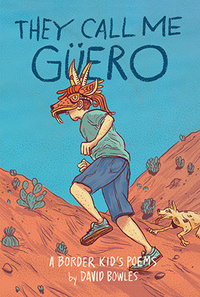 THEY CALL ME GÜERO by David Bowles is a collection of poems which together form a loose narrative about a boy living in South Texas and occupying the physical but also social and emotional space that spans the US-Mexico border. The poems are short and ring clear with emotional and physical details that will strike a chord with any reader. There are many words in Spanish but none that would be a barrier to a reader who knows only English. The glossary in the back is more a courtesy than a necessity. Teachers will be delighted to find many poetic forms and devices used throughout which make it ideal for using in school. I also found it notable in that it doesn’t shy away from the main character’s spiritual practice. A gem from Cinco Puntos Press
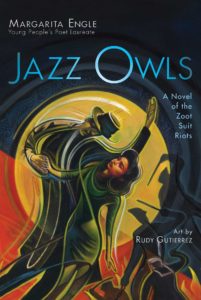 My favorite verse novel in quite a while is JAZZ OWLS: A NOVEL OF THE ZOOT SUIT RIOTS by Young People’s Poet Laureate, Margarita Engle. She takes on an episode in our national history that should be far better known–a racially targeted riot between soon to deploy WWII sailors in Los Angeles and the Hispanic community there. Engle’s spare language and vivid descriptions bring to life a time when the military was still racially segregated, a time when interracial marriage was not legal in California–only 75 years ago. This would be such a great book to discuss in a classroom or book club. The references and afterward make it clear that, as vicious as the racial attacks on Mexican-American’s were, justice was done in the end. The military did integrate and freedom to marry a person of another race did become legal. Still it’s chilling to see how easily the sailors of the 1940s found it to scape goat the Mexican community and how reluctant local law enforcement was to arrest servicemen on the eve of deployment. The art by Rudy Guitierrez strikes just the right tone. This is a gem of a book which I hope will find its way into many a high school history class.
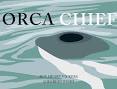 Orca Chief is also a story about the importance of respect for the natural world. In this story a group of disrespectful fishermen are taken under the sea to visit the Chief of the Orcas. After the fishermen apologize the Orca Chief forgives them and shows them ways to find many good things to eat–herrings, oolichan, and crabs.
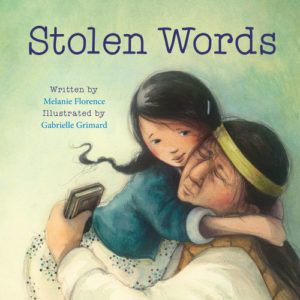 Writing about the ravages of colonial control over First Nations in the United States and Canada is difficult enough when addressing adults. It’s even more challenging when presenting material to the youngest readers. How to convey the seriousness and depth of pain without crushing the spirit of the child reader–it’s a huge challenge, and I admire any author who even attempts to take it on. Few come out with such a successful result as author Melanie Florence in her picture book Stolen Words about her grandfather’s forced enrollment in boarding school and the loss of his mother tongue. Ms. Florence tells the story of a young girl who innocently asks her grandfather how to say grandpa in Cree. He tells her about being taken away from home and punished at the boarding school for speaking his Cree language. Illustrator Gabrielle Grimard captures this beautifully representing the Cree language as a blackbird captured in a cage and locked away. It’s an image that conveys the sadness and brutality of the Canadian boarding school without presenting images too heart-breaking for young readers. The girl finds a Cree dictionary in her own school and brings it to her grandfather and the words on the page, again symbolically, take the fo
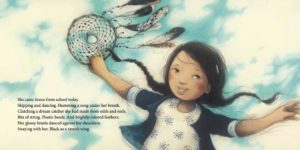 rm of blackbirds and fly free. It’s a simple tale–too simple for older readers certainly who need much more substance and a less tidy resolution. But for the youngest readers this is an important story of native language denied and ultimately regained, and a book well worth celebrating.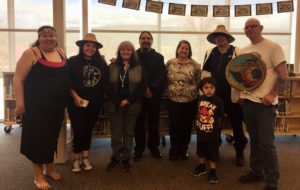
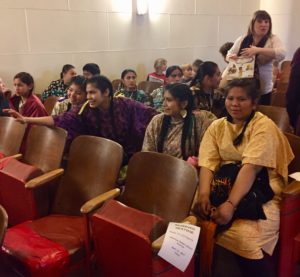
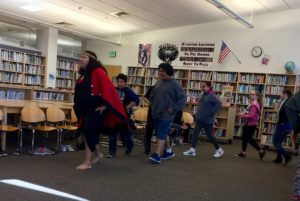 A lot of the work of being an author is the dull and dry sitting at a desk (even when that desk is in a tree) and writing day after day. But every now and then an event comes along that you know you’ll remember forever. The American Indian Cultural Festival in The Dalles last week was just such a moment. It was a celebration of literature and poetry and music and dance. It involved a group of books that I admire and authors I feel honored to share the stage with: Elizabeth Woody, Oregon’s Poet Laureate, Craig Lesley, acclaimed author of contemporary western literature, and National Book Award winning writer Sherman Alexie.
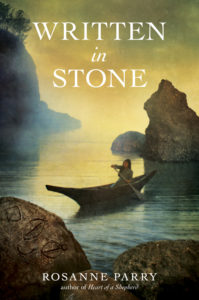 conjunction with the great booksellers at Oregon’s oldest bookstore Klindt’s who sold all the books and hosted many of the events. Tina Ontiveros is the manager at Klindt’s and Joaquin Perez is the owner. The fundraising for this event was truly a community affair with donations coming from area schools and libraries, educational foundations, local congregations, Oregon’s poet laureate program, the Wasco County Cultural Trust, the Ford Foundation, the Meyer Memorial Trust, and the Confederated Tribes of the Grande Ronde. It’s inspiring to see so many community members come together in support of literacy and the cultural understanding of our local American Indian communities. Thank you!