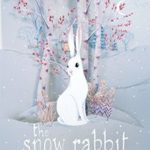
 One of my favorite things about being a bookseller is seeing hundreds of new picture books every year. There is so much talent in the picture book field and such creativity, I find it very inspiring. I’ve had my eye on one illustrator though who’s work I first saw in a modest little book called Fox’s Garden two years ago, and again in the stunning wordless book The Snow Rabbit last year. The artist is Camilee Garoche and she has a such a unique style it catches my eye every time.
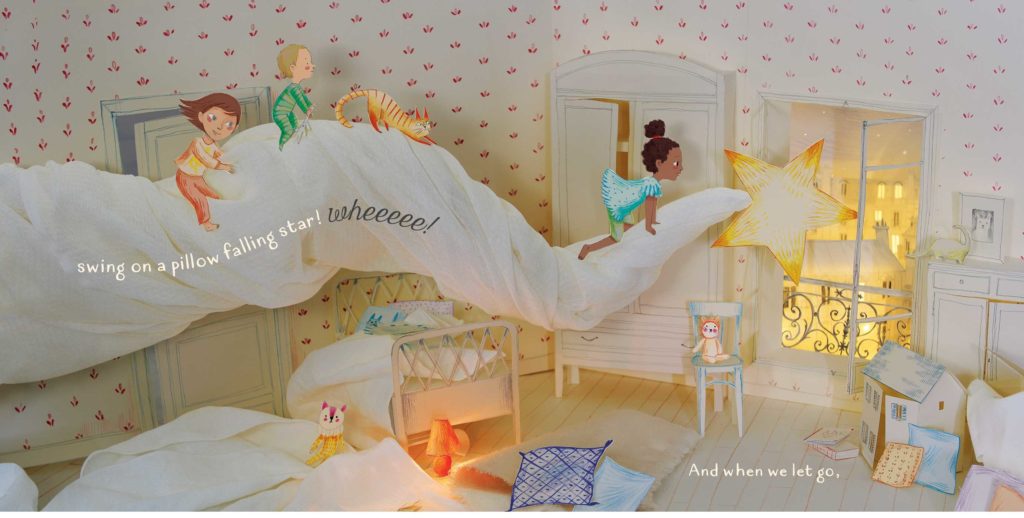 She works in cut paper which is a style I’ve loved ever since my first glimpse of Nikki McClure’s work. But Garoche goes so much further. She cuts a paper scene, embellishes the scene with additional drawing and coloring. Then she lights the scene adding the element of shine and shadow, and then photographs the whole thing. The overall effect is completely enchanting with a depth I haven’t seen in other work.
She’s got a new picture book this year illustrating a song by Laurie Berkner. It’s called Pillowland and I can’t wait to introduce it to families at Annie Blooms Books who are looking for a unique bedtime story.
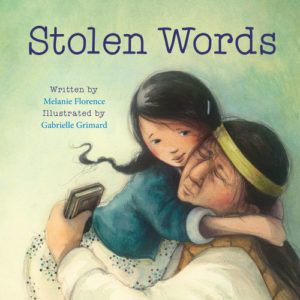 Writing about the ravages of colonial control over First Nations in the United States and Canada is difficult enough when addressing adults. It’s even more challenging when presenting material to the youngest readers. How to convey the seriousness and depth of pain without crushing the spirit of the child reader–it’s a huge challenge, and I admire any author who even attempts to take it on. Few come out with such a successful result as author Melanie Florence in her picture book Stolen Words about her grandfather’s forced enrollment in boarding school and the loss of his mother tongue. Ms. Florence tells the story of a young girl who innocently asks her grandfather how to say grandpa in Cree. He tells her about being taken away from home and punished at the boarding school for speaking his Cree language. Illustrator Gabrielle Grimard captures this beautifully representing the Cree language as a blackbird captured in a cage and locked away. It’s an image that conveys the sadness and brutality of the Canadian boarding school without presenting images too heart-breaking for young readers. The girl finds a Cree dictionary in her own school and brings it to her grandfather and the words on the page, again symbolically, take the fo
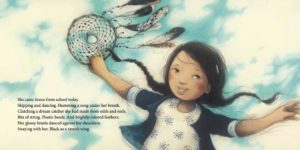 rm of blackbirds and fly free. It’s a simple tale–too simple for older readers certainly who need much more substance and a less tidy resolution. But for the youngest readers this is an important story of native language denied and ultimately regained, and a book well worth celebrating.
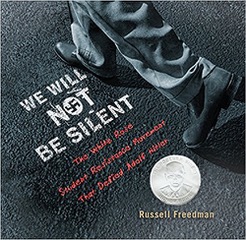 We Will Not Be Silent: The White Rose Student Resistance Movement That Defied Adolf Hitler is the story of Austrian teenagers Hans and Sophie Scholl who at the beginning of Hitler’s rise to power were glad to join the Hitler youth which they saw as a patriotic organization. But as the Hilter Youth moved from scout-like campouts to militia training and racist indoctrination, the Scholl siblings knew they had to resist at any cost. They put together The White Rose, a society devoted to making Hitler’s war crimes known and turning the tide ofGerman popular opinion against the Nazis. They succeeded, although it cost their lives. Freemen’s book is well researched and includes many historical photographs and yet it handles this very dark subject matter in such a way that most elementary school students can understand without being emotionally overwhelmed.
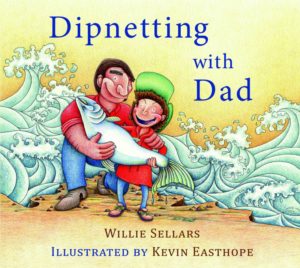 When I was teaching grade school full time, both on the reservation and off, this is exactly the sort of picture book I wanted–a contemporary slice-of-life story about a First Nations family celebrating something important to their culture. I’m particularly exited because this story comes from the salmon fishing peoples of the Pacific Northwest. Author Willie Sellers spins a lively tale of a boy’s first salmon catch using a playful and breezy tone but still conveying many important cultural details, such as preparing for the salmon fishing trip by praying in the sweat lodge and offering tobacco to the Creator. He captures the boy’s nervousness about the steep trail and swift waters of the river. He demonstrates the many steps in preparing dried salmon, with clarity and good humor. Willie Sellars is a T’exelc–a member of the Williams Lake Indian Band. He is a life long fisherman and perhaps what I love the most about this book is the way he conveys the warmth and humor of this family in his story.